Recently, I decided to move my NGX portfolio from Bamboo to CardinalStone. I had built a sizeable NGX portfolio on Bamboo. It was working, but it also felt scattered.
While part of my holdings sat inside Bamboo, another part sat inside my CardinalStone account. As my portfolio grew, I realised that wealth does not only grow through good investments. It also grows through clarity, structure, and control. I wanted one clear home for my Nigerian equities, one consolidated view, and one institutional relationship that could support me as my portfolio continued to expand.
So, I decided to move everything to Cardinal Stone, and that decision triggered a couple of questions.
Would I lose my shares?
Would they be sold automatically?
Would taxes apply?
Would the process drag for months?
I couldn’t find an updated, clear guide for Nigerians doing this exact transfer. So I documented everything. This article is that documentation.
By the end of this guide, you will know exactly what to do, and you will be able to execute it confidently today.
1. First, understand what a “transfer” really means
The most important thing to understand is this. Your shares are not stored inside Bamboo or CardinalStone. They are held inside a central system called CSCS (Central Securities Clearing System). As custodians connected to that system, Brokers like Bamboo and CardinalStone simply provide access to that system and manage your holdings within it.
So when you transfer your portfolio, nothing is sold. Nothing is converted to cash. CSCS simply moves your shares from one broker’s custody position to another, based on your written instruction.
It is very similar to moving money from one bank to another. Your money does not disappear. It simply moves under a different institution’s management.
Once you understand this, most of the fear disappears.
2. Prepare these essentials before starting
Before initiating the transfer, make sure you have the following ready:
- An active CardinalStone brokerage account (you open one and get your CSCS number. You can open one here)
- Your CardinalStone CSCS number
- Your Bamboo-linked CSCS number
- Your CHN number (Clearing House Number)
- Your official CSCS statement from Bamboo
- A valid government ID
- A recent utility bill
If you do not have your CSCS or CHN details, simply email Bamboo at support@investbamboo.com and request your CSCS statement and account details, and your intention to move your portfolio to another broker. They will provide everything you need.
Also note that CardinalStone typically processes inter-member transfers for portfolios above ₦1 million. This ensures the relationship is meaningful and properly supported.
Before sending a single email, make sure you have:
- An active CardinalStone brokerage account
- Your CardinalStone CSCS number
- Your Bamboo-linked CSCS number
- Your CHN number (Clearing House Number)
- An official CSCS statement from Bamboo
- Valid ID
- Recent utility bill (in case requested)
3. Step-by-step: the exact process I followed
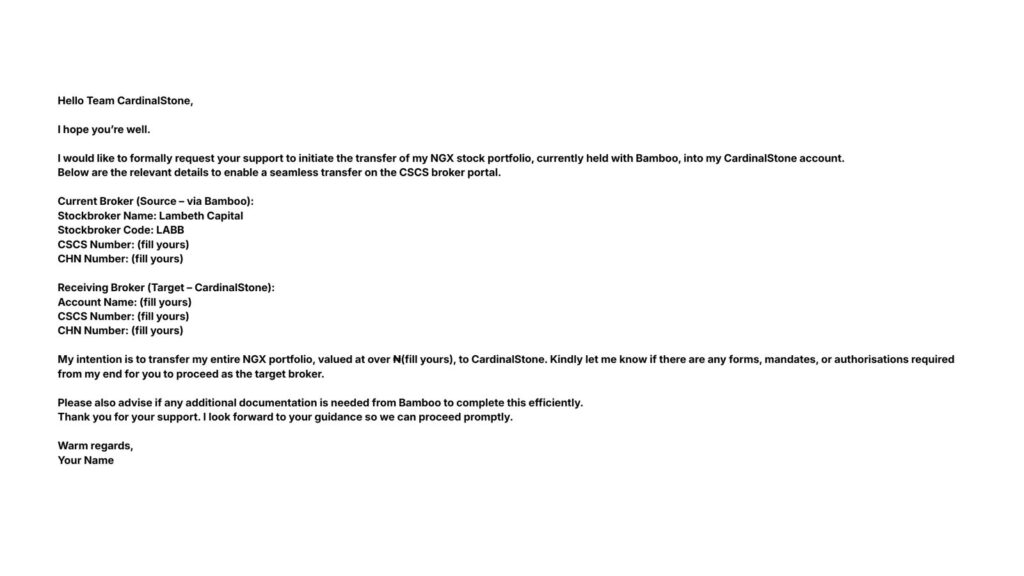
Step 1: Email CardinalStone and request the transfer
This is where everything begins. Once you have all your details from Bamboo, the receiving broker, CardinalStone, will guide and initiate the process.
Send an email to: crd@cardinalstone.com
Subject: Request to Transfer NGX Portfolio from Bamboo to CardinalStone
In your email, include:
- Your full name
- Your CardinalStone CSCS number
- Your Bamboo CSCS number
- Your CHN number
- The resident broker name (usually Lambeth Capital for Bamboo NGX stocks)
This email formally instructs CardinalStone to begin moving your holdings.
[Feel free to use the sample email below]
Step 2: Send your official CSCS statement when requested
After your initial email, CardinalStone will ask for your official CSCS statement from your Bamboo-linked broker.
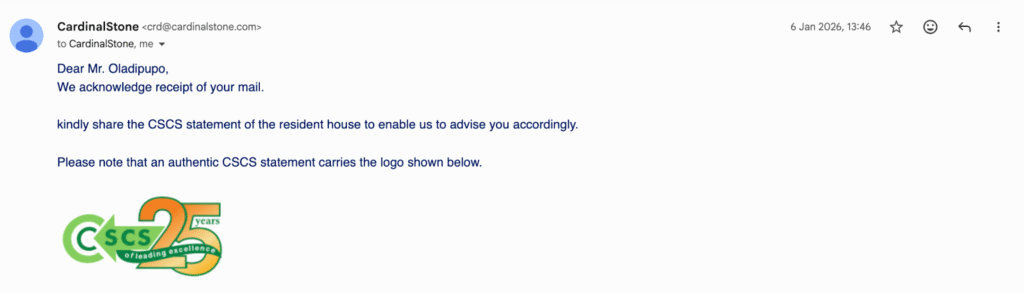
This statement confirms your ownership and authorises the transfer.
Request it from Bamboo if you don’t already have it, and forward it to CardinalStone.
[Feel free to use the sample email below]
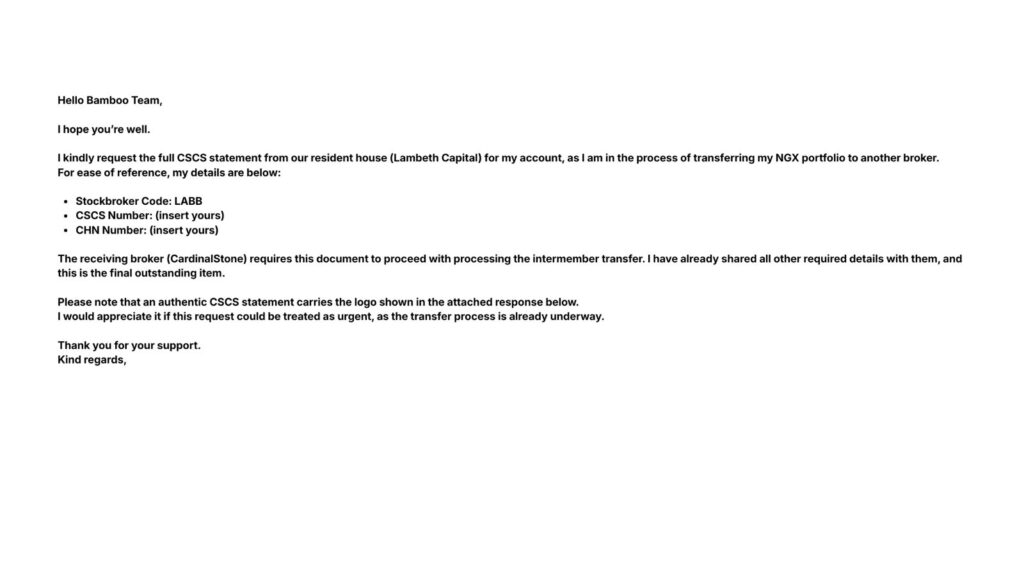
This step confirms to both brokers that the holdings exist and can be moved.
Step 3: Complete and sign the transfer forms CardinalStone sends you
CardinalStone will send you a small set of documents. These typically include:
- A letter of authority
- An inter-member transfer form
- Instruction templates
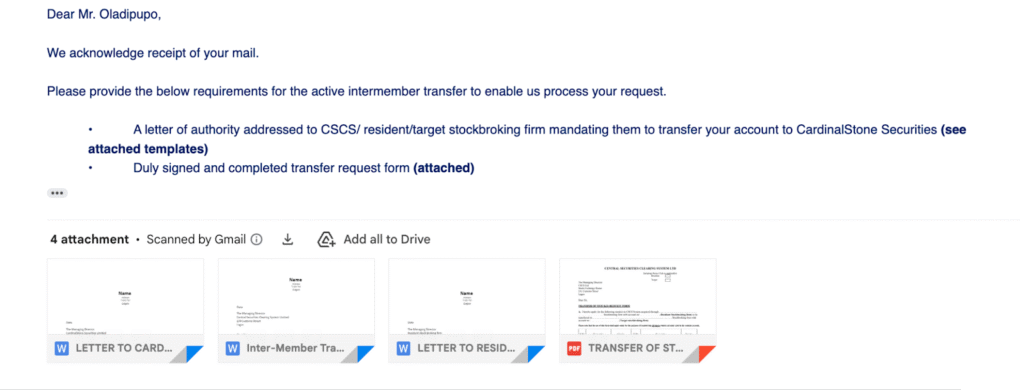
Carefully fill them out, sign them, and return them as PDFs.
These forms are your formal legal instruction authorising CSCS to move your shares.

Once submitted, CardinalStone forwards everything to the resident broker.
Step 4: Complete the resident broker’s release requirements
This is the stage where Bamboo’s resident broker (usually Lambeth Capital) confirms your identity and releases the shares.
You may be asked to provide:
- Valid ID
- Recent utility bill
- Completed update form
- Letter of instruction
- Processing fee (₦10,000 in my case)
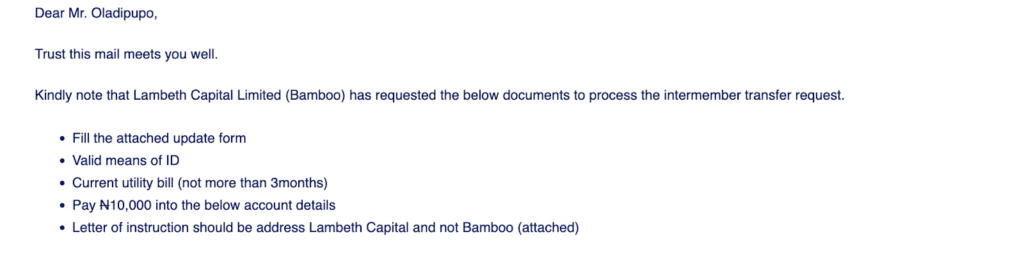
This step ensures that no unauthorised person can move your assets.
Once you submit these items, the resident broker approves the release.

Step 5: Receive confirmation and verify your shares have arrived
After approval, CardinalStone will notify you that your portfolio has been moved successfully.
They will also send your updated CSCS statement reflecting your holdings under CardinalStone’s custody.
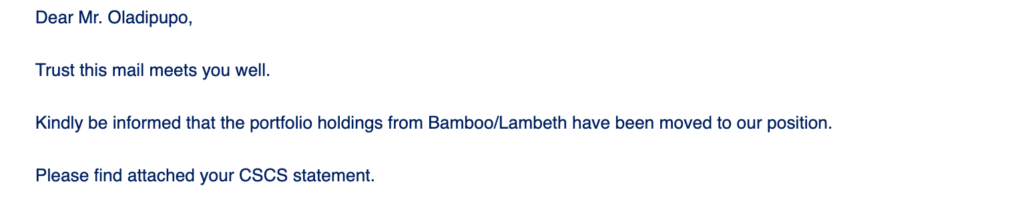
At this point, your shares are fully transferred. They remain exactly as they were, with the same quantities and ownership history intact.
Nothing has been sold. Nothing has been lost.
4. How long the process actually takes
Here was my real timeline:
- January 5: Initial request sent
- January 6: CSCS statement requested
- January 9: Forms submitted
- January 19: Final broker requirements completed
- January 20: Transfer confirmed
In total, the process took about two weeks. This is normal. Most of the time is spent waiting for document verification, not actual asset movement.
5. Mistakes that delay transfers (and how to avoid them)
Most delays happen when small details are missed.
Avoid these common mistakes:
- Sending screenshots instead of official CSCS statement
- Forgetting to sign transfer forms
- Providing unclear or expired ID
- Addressing instruction letters incorrectly
- Delaying processing fee submission
When everything is submitted cleanly, the process moves smoothly.
6. What happens after the transfer is complete
Once completed, your shares will appear inside your CardinalStone portfolio.
Your ownership history remains intact. Your dividends will continue to be paid normally by company registrars into your bank account. Nothing resets and nothing is lost.
The only difference is that CardinalStone now manages the custody and execution of your holdings.
7. The deeper lesson most investors miss
What surprised me most was not the technical ease of the transfer. It was the psychological clarity that came after.
When your assets are scattered, your attention is scattered. You hesitate more. You check multiple platforms. You think in fragments.
But when your assets are structured, your thinking becomes structured. You see clearly, plan clearly, and grow confidently.
This is one of the key transitions from being someone who buys stocks to someone who truly manages wealth. Because real wealth is not just about what you own.
It is about knowing exactly where it lives, how it is held, and having the confidence to move it deliberately when necessary. Now you know exactly how to do that.
As always, we’re rooting for you!