
How solving real problems can help you build income in Nigeria
Turn a useful skill into a clearer business offer by testing customer needs, pricing the full cost and separating revenue, profit and cash.
Growing up, I sometimes thought wealth belonged to people who were lucky or connected. Experience taught me to pay closer attention to usefulness: what people need, what they will pay for and whether a business can deliver it consistently.
Solving a real problem can create income, but it is not a guarantee of wealth. Access to customers, capital, pricing, competition and costs all affect the result. A useful idea needs a workable business around it.
Look for a problem people already try to solve
A shopkeeper losing sales while waiting for a faulty fridge to be repaired has a different need from someone who might enjoy a new app someday. Ask what the problem costs, how often it happens and what the person currently does about it.
You can start with the people and businesses you understand. Listen before offering a solution. A customer who says an idea sounds interesting has not yet shown that they will pay for it.
Describe a small, clear offer
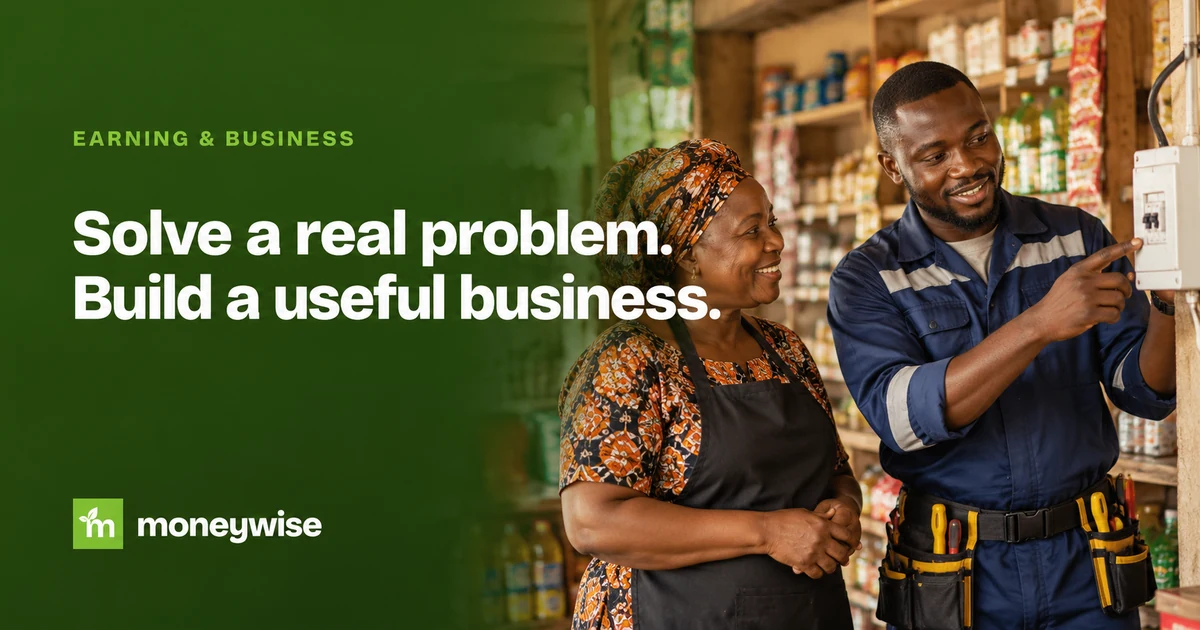
Imagine, for illustration, an electrician offering scheduled maintenance to a few shops. “I do electrical work” is broad. Explaining the type of inspection, what is included, the price and when the customer can expect it makes the offer easier to assess.
Choose a promise you can actually deliver. Do not offer a response time, safety certification or technical capability you do not have. In regulated work, verify and meet the relevant requirements before selling the service.
Test willingness to pay before spending heavily
Speak to potential customers, demonstrate what you can do and, where appropriate, run a small paid trial with clear terms. Watch what people use, what they return for and why others decline.
A small honest test can reveal that the buyer is different from the user, the timing is inconvenient or the problem is less urgent than you thought. That information can save you from buying equipment or stock before the offer works.
Revenue is not the same as wealth
One million customers paying ₦1,000 produces ₦1 billion of revenue before costs. It does not produce ₦1 billion of profit, and reaching those customers may require considerable spending. A large multiplication can illustrate scale without proving that a business is viable.
Consider a hypothetical service sold for ₦20,000. If materials cost ₦6,000, travel ₦2,000 and delivery labour ₦7,000, ₦5,000 remains before overheads, taxes and other costs. Leaving out your own labour can make the business appear more profitable than it is.
Check when the money arrives
An order is not always cash in the bank. If a customer pays after 30 days while your supplier needs payment now, the business needs a way to cover that gap. Agree payment terms in writing and track what is owed.
Keep business and household records separate enough to understand both. Decide what you can take from the business without using the money needed for stock, delivery or other commitments.
Build trust through reliable delivery
Confirm what the customer is buying, keep appointments, explain changes early and handle a problem respectfully. Ask for feedback and permission before using someone’s comments as a testimonial.
Reliability can make repeat business more likely, but do not assume that a happy customer will automatically bring ten more. Track where enquiries come from and whether serving each customer leaves a sustainable margin.
Use support that matches your stage
SMEDAN describes business support and entrepreneurship training, and its ICSS programme page provides a route to learning resources. Check current eligibility and terms rather than assuming every programme includes finance.
If you already have a suitable startup, our accelerator research guide explains how to compare programmes. Do not spend all your time applying while neglecting the customer problem.
Choose one useful experiment
Write down who you want to serve, the specific difficulty they face, your proposed offer and the full cost of delivering it. Then arrange a small test that your budget can support.
The first ambition does not have to be a million customers. It can be understanding a few customers well enough to serve them reliably and earn something sustainable. That gives the next stage of the business a firmer foundation.
Updated on 24 October 2026. Examples are illustrative. Choose financial products and commitments according to your circumstances and their current terms.